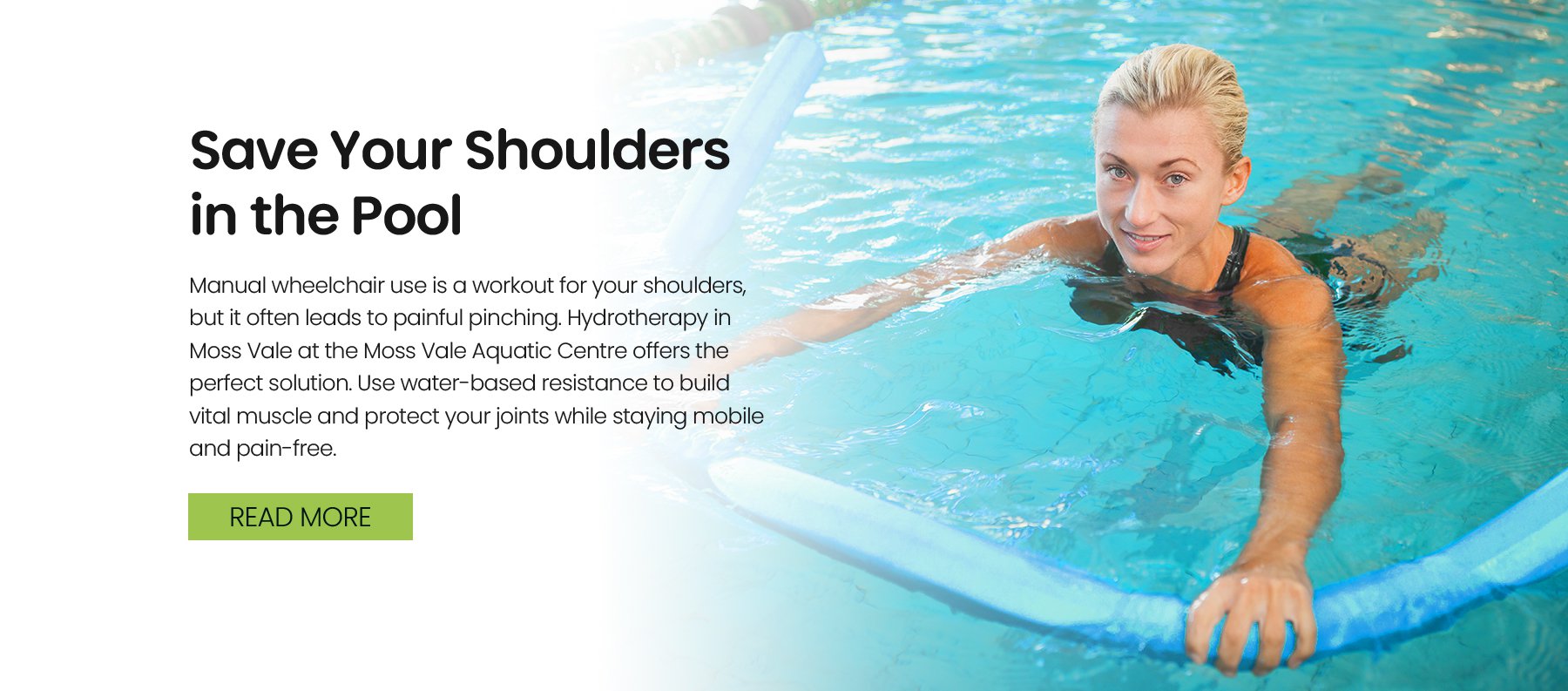
For manual wheelchair users, the shoulders are more than just joints, they are the primary engines of independence. From the moment you wake up to the moment you transfer into bed, your upper body performs thousands of repetitions of the "push" motion. While this builds functional strength, it also places an extraordinary "shoulder tax" on the rotator cuff and glenohumeral joint. Over time, the repetitive nature of self propulsion can lead to impingement, chronic inflammation, and muscle imbalances.
At Healthstin, we recognise that maintaining shoulder health isn’t just about avoiding pain; it’s about preserving your lifestyle. This is where Hydrotherapy at Moss Vale becomes a game changer. By transitioning your strength training and recovery into the water, you can build the muscle you need to remain mobile while simultaneously unloading the joints that work so hard on land.
The "Shoulder Tax" of Manual Propulsion
Think of pushing a manual wheelchair like a lopsided tug of war. Your chest and the front of your shoulders are doing the heavy lifting, while your back muscles are basically sitting on the sidelines.
Because the front of your body is working so much harder than the back, it creates a few specific issues:
- The "Forward Slump": The strong chest muscles pull your shoulders forward into a rounded position.
- The Pinch: This rounded posture leaves less room inside your shoulder joint.
- The Pain: With less room to move, the tendons inside get squeezed or pinched, which is what causes that all too common shoulder pain.
In short, your "pushing muscles" are overtrained, and your "pulling muscles" are taking an accidental vacation, leaving your shoulder joints caught in the middle.
On land, traditional weight training can sometimes make it worse. If a wheelchair user lifts weights to build strength, they are often adding more compressive force to a joint that is already under stress. Water based rehabilitation offers a unique solution by utilising buoyancy to counteract gravity, effectively "opening up" the joint space while providing the resistance needed for muscle hypertrophy.
Why the Moss Vale Aquatic Centre?
Accessing high quality facilities is the first step toward recovery. Utilising the Moss Vale Aquatic Centre allows users to work in a temperature controlled environment where the water is typically maintained at 32°C to 34°C. This warmth is crucial because it:
- Increases Blood Flow: Warmth dilates blood vessels, bringing oxygen rich blood to the rotator cuff tendons.
- Reduces Muscle Spasticity: For those dealing with high muscle tone, the warmth helps the body relax.
- Improves Flexibility: The heat makes the collagen in your ligaments more pliable, allowing for a better range of motion during your session.
The Science of Resistance Without Impact
The primary benefit of Hydrotherapy for shoulder rehabilitation is the nature of aquatic resistance. Unlike a dumbbell, which provides resistance only in the direction of gravity (downward), water provides viscous resistance in all directions.
In the pool, the faster you move, the harder the water pushes back. This allows for a completely customisable resistance level that adapts to your strength in real time.
This omnidirectional resistance is vital for manual wheelchair users because it enables "pulling" movements that are difficult to replicate safely on land without straining the neck or lower back. By focusing on the posterior chain (the muscles on your back), hydrotherapy helps pull the shoulders back into a neutral, healthy alignment.
Essential Hydrotherapy Shoulder Exercises
When you work with a Healthstin therapist, your program will be tailored to your specific functional goals. Several core exercises form the foundation of a shoulder preservation program:
| Exercise | Primary Target | Benefit for Wheelchair Users |
|---|---|---|
| Horizontal Sculling |
Rotator Cuff | Stabilises the “ball” in the “socket” of the shoulder. |
| Water Wings | Posterior Deltoids | Counteracts the forward-leaning “wheelchair posture.” |
| Vertical Press Downs |
Lats & Triceps | Strengthens the muscles needed for safe transfers. |
| The Piston | Serratus Anterior | Improves scapular stability to support movement. |
Building Muscle While Protecting the Joint
Many people mistake hydrotherapy for "easy" movement. In reality, it is a potent environment for muscle growth. Because water is roughly 800 times denser than air, every movement requires significant muscular engagement.
For a wheelchair user, building the triceps and latissimus dorsi is essential for performing transfers. In the pool, we can perform high intensity "dip" motions along the edge. Because the water supports up to 90% of your body weight, the initial "lift" is easier on the shoulder capsule. Still, the constant resistance throughout the movement ensures the muscle fibres are being challenged.
Long Term Outcomes of Aquatic Therapy
Engaging in regular Hydrotherapy in Moss Vale does more than address current discomfort. It creates a "buffer" for the future. By building a balanced muscular "corset" around the shoulder joint, you aim to reduce the risk of:
- Rotator Cuff Tears: Stronger muscles take the load off the tendons.
- Bursitis: Reduced friction in the joint reduces inflammation.
- Loss of Independence: Healthy shoulders mean more years of self-propulsion and easier daily living tasks.
A Holistic Approach with Healthstin
At Healthstin, we don't just look at the shoulder in isolation. We look at how your shoulders interact with your trunk and your specific wheelchair setup. Our sessions at the Moss Vale Aquatic Centre are designed to be functional, goal oriented, and most importantly, sustainable.
If you have been feeling that familiar "twinge" during your morning commute or finding transfers more taxing than they used to be, it might be time to take the pressure off. Hydrotherapy for shoulder rehabilitation isn't about doing less; it’s about doing more in an environment that respects the anatomy of a manual wheelchair user.
The water is waiting, and your shoulders will thank you for the relief.
Healthstin offers hydrotherapy pools in Moss Vale clinic to serve as a venue for water based exercises. Its experienced Exercise Physiologists and Therapists conduct hydrotherapy treatments to help people, including those suffering from arthritis, to gain the most benefit from water based exercise while minimising joint pain. If you want to get into hydrotherapy classes, just call 1300 090 931 or book here.